
When, where and why did your passion for photography begin? How have these years of fervent technological evolution passed through your work?
When I graduated from Cambridge after studying philosophy and sociology, I wanted to explore the world as a journalist. I loved the idea of photography because the image is a universal language that can reach beyond cultures and social spectra.
So I applied to Reuters news agency to join their photo team. But the editor who interviewed me thought my profile was better applied to text, so I became their correspondent, writing about political and social issues in China. Within a short time the company placed me at the head of a small bureau. I loved the intellectual challenge of interviewing people, but I missed the proximity to real life. Often I found myself writing stories about faraway events, such as an earthquake, just by calling local authorities or even watching live TV. The photographers jumped on the first flight in their combat clothing and came back with crazy tales of adventure. I could not resist.
I told my editor I was to leave my work in Asia to join my girlfriend in Amsterdam and begin a career as an independent photographer. He almost swivelled off the office chair when he turned to me and said, “Look, there are 3,000 freelance photographers lining the streets of Paris and Amsterdam. A new guy from Hong Kong? It’s just not going to work.”
I went ahead anyway, believing I could make better work as an independent photographer. It was perhaps the most irrational decision I’ve ever made, throwing away a life of comfort for insecurity.
There was some early success. My first story was published in a dozen international magazines, including the National Geographic. The World Press Photo selected me to participate in the Joop Swart Masterclass among 12 promising newcomers from around the world. The great motivation this gave me eventually seemed more like a false sense of security, because it’s really challenging to stay consistently in the game.
I realised how powerful the corporate media machines are. However, by staying small, I could apply a bespoke approach to visual projects, explore stories with a unique point of view, and craft them in a powerful way that stand out from the crowd.
What do you want to express, transmit or represent through your images and your style?
In all my work, I am guided by one key value, and that is meaning.
Meaning guides me in finding a story idea. For this investigative process to be meaningful to me, I must research my ideas on real subjects and places – hence documentary.
It helps me compose my pictures. For it is no use in finding meaning but not conveying it in the most powerful way possible.
It helps me answer all kinds of moral questions. To pose, or not pose, for example. To me, there’s really no point faking pictures during the shoot or in photoshop, even when nobody sees me doing it, because the pictures lose meaning for me. Whenever I pose a picture, it dies in my heart.
Meaning guides me when I am editing. I edit my pictures like a film, with strong narratives and story elements. Where a picture looks nice but doesn’t tell a meaningful enough story, it goes into the bin.
Finally, meaning helps me sell my stories. When after all this work, I am able to explain to the editors the relevance of my story and why they should publish it, Right Now!
You know, some people quietly jeer at you when you talk of changing the world. They might think, you can’t even change yourself. I disagree.
We are witness to moments of history, kindness and love, we also use our cameras to testify against brutality, prejudice and injustice. It is up to you to add value to the world, by making images that inform people, touch their hearts and move them to action.
But this happens if, and only if, your stories have meaning.
In your opinion, what is the most important element that could make a photograph great? The light? The composition? Technical perfection?
When I started out as a journalist for Reuters, learnt how to report accurately and without bias. As my work developed and I carved out an independent path, I took as my mission to tell stories that reveal a deeper truth, challenge perceptions, and inspire positive action. I wanted to create unique stories that takes on a longer term meaning.
Today, I enjoy work with some of the world most reputable publications, institutions and brands, helping them to tell real stories and connect to their audience across continents.
But how do you stay true to reality under commercial pressure? This is a tough call. As a photographer, your client wants a smashing picture, and the viewer increasing expect strong visual impact. The temptation is, of course, to manipulate.
Since I have staked my reputation on finding real stories and telling them in an authentic way, I try to create impactful images by using the real world as my theatre, real people as my subjects, and real life as stories. This, therefore, means i get close to people, win trust and be that invisible fly on the wall.
Getting to the heart of a reality and telling it in a meaningful way is thus something that I do on each assignment.
And to convey this meaning, I would use light and composition to emphasize or balance elements. The best situation is when the technicality of the image is inherent in the meaning of it. When you have to force a composition to suit a story, it risks being forced and repetitive.
Where do you get your inspiration from? How do you organize your photographic projects both for what concerns subjects / locations and for what is relative to the work on the field?
I find inspiration shooting in the former Soviet and Communist space, such as Russia and China, because the architecture of power creates a culture that is monolithic on the outside, but warm and individual inside. Moscow, Novy Urengoi, Beijing, all these places are like concrete bunkers, cold and unwelcoming, but once you find a way to penetrate and meet real people, you’d discover the most wonderful hospitality and warmth. It’s magic.
When i’m not walking the streets, I get my ideas from having a general awareness of world affairs by reading widely, from the New York Times and the Economist to publications in the Chinese and Russian spheres. To get actual stories, however, I keep my eyes and ears open when traveling and meeting people.
What do you think are the main limitations of newbies photographers who try their hand in your field? And what are, in your opinion, the main difficulties typical for this photographic genre?
Documentary photography has been a tough, lonely road with occasional nuggets of gold and wonder. Perhaps, if I had chosen another career, life would have been a lot easier, especially now that I have a wife and three kids who depend on me. I believe you have to do projects you truly believe in, have unique access to and have the persistence to carry to the end, no matter how much it takes. Then, maybe, you can infect others with your enthusiasm (and good pictures, hopefully!).
The best way to start in photo journalism is to go travel. Make new friends. Learn another language, get out of your comfort zone.
It is not enough to just capture a situation in an image. As a journalist you are an interpreter, and you need a good grasps of the cultural and historical contexts. You also need emotional connection.
Speaking different languages connects you not just to the person you are in direct conversation with, but you also hear about all the chatter in the background, and all the discussions you are not supposed to hear. This helps in knowing who really are the decision makers when trying to gain access to situations and people. Being bilingual in English and Chinese, and conversant in Russian, French and Dutch, I enjoy the ease of opening doors to amazing stories and people.
So, if I have to choose how I spend a year, I’d rather learn a new language or submerge myself in an interesting subculture than just photographic technique.
Does technical equipment influence the aesthetic result of images and projects? Can you please tell us what is your standard equipment for professional commitments or for a personal job?
On the one hand, I remind myself and that it’s the photographer who makes the pictures, and I urge people who ask for my advice to look more inside themselves than to fuss too much about equipment. That said, great cameras enable you to accomplish great things especially under challenging situations. In choosing my equipment, I would look beyond the headline numbers and try to understand the camera maker’s philosophy and figure out what the camera, as a system, enables the photographer to do.
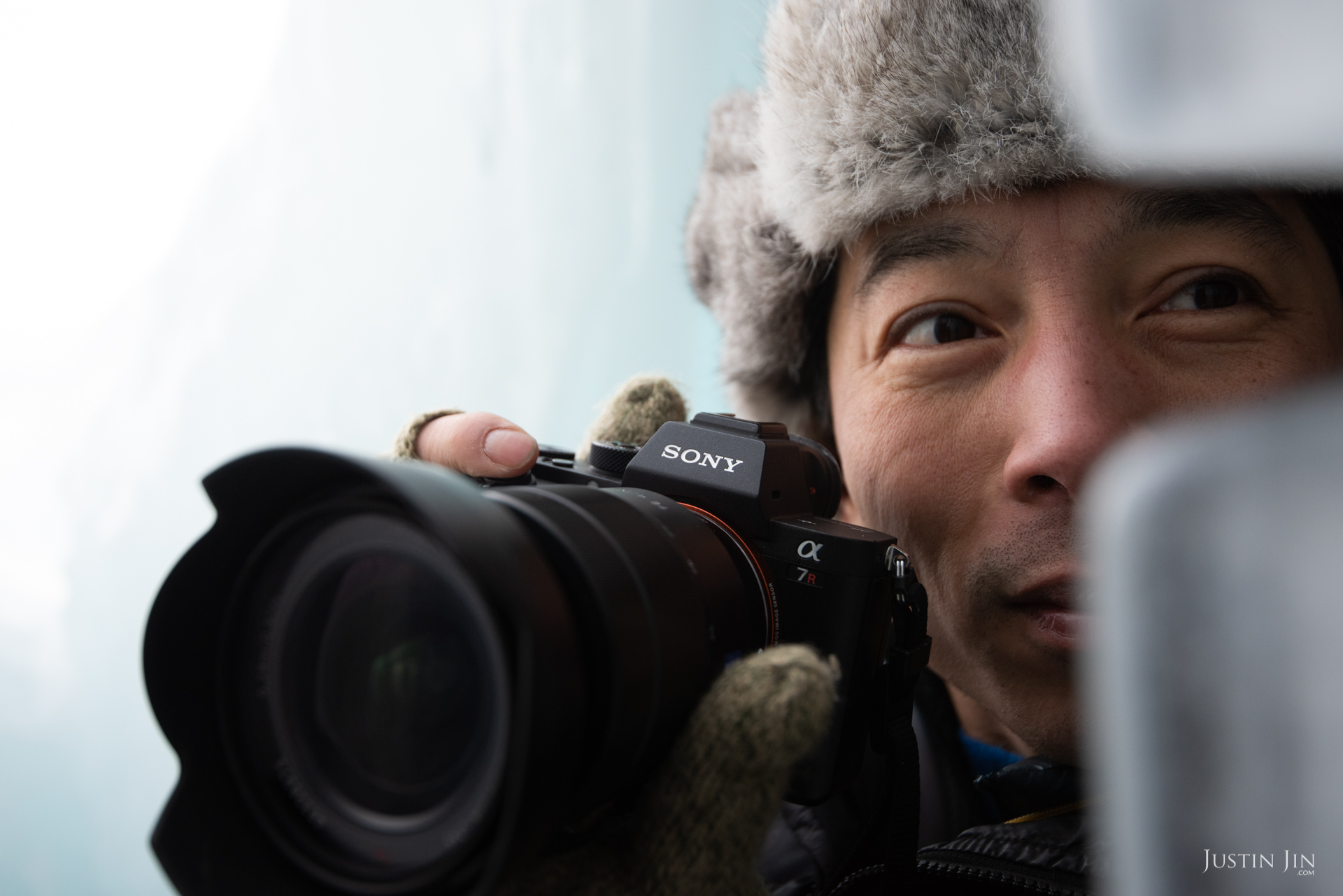
I mainly use the A7 series (currently A7RIII) and the “holy trinity” of zoom lenses: 16 -35 / 4; 28-70/2.8; 70-200/2.8. It’s a relatively light set-up that enables me to work capture spontaneous moments, and extend my range for landscapes and portraits when needed.
When I shoot street stuff in more repressive places such as China and Russia, I would either put a smaller lens or switch to my RX100V.
When I shoot portraits I would also use a 85/1.4, which give incredible feeling of presence.
How did you come into contact with the Sony photographic world? How did you come to the mirrorless world from the (D)SLR world? The main advantages? And the limits?
For a decade and a half, I was shooting with Canon and Leica equipment. When I roamed outdoors doing street photography I would have a M4 or M7 around my neck because they are so discrete and light. Once I get inside certain situations when the subject has gotten used to me, I would take out my latest version of a Canon 5D for more shooting power.
3 years ago, I was shooting a large project about urbanisation in China for various media, including the New York Times, when Sony approached a group of us to see who might be interested in testing out the Sony equipment.
I never thought of Sony as a camera maker and was sceptical at first. But within the first few days of trying out the A7s with a couple of lenses, I was a convert, and shelved all the Leica’s and Canon’s I had lovingly accumulated over the years.
Here I had a Sony that combined the best of both brands, and more! Not only was the Sony small and silent, successive iterations of the Alpha series showed massive technological advancement. For me, the A7RIII made more technological sense than either the legacy rangefinder or DSLR systems. The large frame sensor of course beats out all other mirrorless for me. I can continue to shoot narrow depth-of-field work. The other advantages are numerous, from ergonomics such as the flip-view-screen that enables me to be utterly discreet while shooting street photography, to details including the eye-focus, high ISO and five-stop optical stabiliser.
Sony has since appointed me its global imaging ambassador. This is to say Sony offers me equipment, and in return, I share with the company some of my work and time.
During my speech at the Sony Alpha Convention in the Netherlands last month given to photo magazine editors, trade partners and consumers, someone in the audience asked if I think my review of Sony’s equipment is inherently biased given my relationship with the brand.
Yes, I am going to be pre-disposed to thinking good of a company that gives me its latest gear.
But we have to realise that equipment is just one part of the cost, and often a small part. The cost of sending me on an editorial assignment could be EUR10k or 20k, and a commercial assignment are many times more. Over the course of a year, the cost of my camera and lenses is a small fraction of my photography business. Yet, they play an outsize role in the quality of my final artwork. If for any reason I get sub-optimal results from my camera, it would cost me so much more in terms of reputation.
So I’m going to choose the best equipment whether I get it for free or have to pay for it. The Sony system supremely combines small size, large quality sensor and amazing tech — that’s best out there for my range of work. Period.
Please give us a synthetic evaluation of these ‘topical’ elements when photographing with a Sony-branded mirrorless?
– Reliability of the autofocus in critical situations
The autofocus started out a bit slow in the first generations but is making huge progress. I especially like the eye-focus, which has given me much higher success rate with portraits.
– G Master optics
I must say I’m not overly picky about technical details such as corner sharpness and light fall off, but I do notice an incredible amount of details when you enlarge a print that is shot on a 42 megapixel A7RIII.
– Image quality and Raw management
I love the cinematic look that the Alphas give with its large dynamic range. Having a full frame sensor is a dealmaker for me.
– Comfort of vision through the electronic viewfinder
The viewfinder is useful not only in bright conditions, when the sun overpowers the flip screen, but also when you want to fill your entire vision with a scene. When the viewfinder is electronic, you can get all kinds of additional information such as zebras and focus peaking, as well as adjust for brightness. The new finders are so sharp they hardly make a difference with optical finders.
– Ergonomics in field use, autonomy, structural reliability
A few months ago I spent three weeks shooting along the shores of frozen Lake Baikal in Siberia, with temperatures ranging from -30c outdoor to +25c indoor, everywhere is ice, snow and vapour.
Not only did the camera survived, I find the electronic shutter a great advantage to a mechanic one. It operated quietly and smoothly throughout.
When I was in a similar situation shooting in the Arctic a few years ago, I had three DSLR cameras with me, and broke two by forcing the camera shutters to work while they froze. When I took them for repair the technician was dumbfounded by the internal damage and had to replace both shutters.
Another note about batteries. Power shortage was A7RII’s achilles heel, and I typically carried 10 batteries with me.
This has been significantly changed in the A9 and A7RIII. With a much larger battery, I was able to shoot in Siberian winter using around 1.5 batteries a day, which was a real stunner.
The earlier Alphas were very fragile, but they are becoming increasingly robust. Still not a tank like a Leica or Canon, but getting there.
Both the optical park and the new generation of Sony cameras are taking on more and more influence. What are in your opinion the bodies and the lenses that can testify the most, today, the real potentials of this system?
For me by far it’s the bodies. They are very light and high-tech, built from ground up with the latest digital formats in mind, a perfect extension of my eyes and arms.
The lens are totally fine too, but they don’t feel as revolutionary. Their large size off-sets the discreetness of the bodies. Back to my Leica-Canon allegory, in my mind the Sony bodies are a tiny Leica with the raw power of a large Canon. I hope one day the lenses would be like that, too.
We know that size and weight of equipment can be a problem in certain locations. Has the mirrorless world really changed the cards on the table or does this only apply to the amateur photographer who always goes around with the same standard lens kit?
What is your typical editing workflow in post-production?
Lightroom. For retouching that are more complicated, I would ask someone else to photoshop for me.
Are there any curious or funny facts to tell you happened while you were shooting?
A ton!